Journalism and Psychological Trauma
Readings, assignments and weekly schedules for Temple University course Journalism 3700: Journalism and Psychological Trauma.
Course Description
This course will introduce students to the special challenges and responsibilities of covering traumatic events in the news, from urban violence and school shootings to man-made and natural disasters, terrorist attacks and foreign wars. Primary concerns will include the ethical treatment of victims and survivors, the impact of trauma coverage on news consumers and communities, complete and accurate reporting under stress, and the psychological hazards of traumatic events for the news professionals who cover them.
Required Reading
-
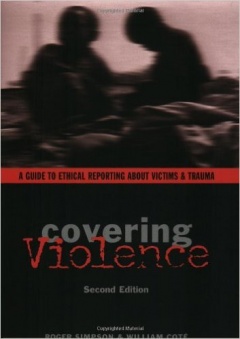
Covering Violence: A Guide to Ethical Reporting About Victims & Trauma
By Roger Simpson & William Coté
Publisher: Columbia University Press; second edition (June 13, 2006)
ISBN-10: 0231133936 - ISBN-13: 978-0231133937 -
Journalists under Fire: The Psychological Hazards of Covering War (Hardcover)
by Anthony Feinstein
Publisher: The Johns Hopkins University Press; 1 edition (August 15, 2006)
ISBN-10: 0801884411 - ISBN-13: 978-0801884412 -
Achilles in Vietnam: Combat Trauma and the Undoing of Character (Paperback)
by Jonathan Shay
Publisher: Simon & Schuster; First Touchstone edition (October 1, 1995)
ISBN-10: 0684813211 - ISBN-13: 978-0684813219
Readings will be assigned each week. Texts and additional materials may be included.
Course Structure
Each week will include lectures, discussions, assignment and reading reviews, and when possible, expert guests. All assignments are due at the beginning of the Tuesday class each week. Guests will most often visit on Thursdays.
Course Requirements
All writing assignments must be printed and presented at the beginning of the class on the due dates. All papers must be written in journalistic style, using attributions rather than footnotes.
Reading and Reactions
Due each Tuesday, beginning on January 27 and through April 21
Print and submit three thoughtful questions for discussion, based on the assigned readings.
Media Analysis
Due each Tuesday, beginning on January 27 and through April 21
Submit one report of a traumatic event, either via news clippings or printout from online sources. Audio or video reports are acceptable, but must play on demand, and must be accompanied by a brief printed summary. Each report must come from the previous week, and new since our last meeting. Write a brief response.
Interviews/Presentations
- Find a journalist who has covered a major traumatic event in the news, or has covered a traumatic beat for a significant time. Discuss their personal reactions to these events. Submit five pages. Prepare a three minute presentation. Due February 17.
- Find a survivor of a traumatic event in the news. Discuss their perceptions of news coverage, and it’s effect. Submit five pages. Prepare a three minute presentation. Due March 24.
Final Papers/Presentations
Follow one or more of the major themes presented in class, and combine new data with the course materials to prove a thesis. Submit 10 pages and prepare a 10 minute presentation. Due April 28.
Submit one page with topic(s) for approval as soon as possible, but not later than February 10.
Tentative Schedule
Week 1: January 20 & 22
Trauma 101 - Review of research - Course structure - Introductions
Week 2: January 27 & 29
Effects of coverage on victims and survivors - Guidance for interviewing
Week 3: February 3 & 5
Effects of coverage on the public - Revisiting Virginia Tech
Week 4: February 10 & 12
Effects of trauma on journalists - Terrorism - 9/11, Oklahoma City and foreign attacks.
Submit research paper topics for approval.
Week 5: February 17 & 19
Crime - Murder - Suicide - the urban gun crisis
First interviews - paper and presentations - are due February 17.
Week 6: February 24 & 26
Disasters, natural and human-caused - South Asia tsunami
Week 7: March 3 & 5
War - Emotional and moral injury - Accurate reporting under stress
Spring Break
Week 8: March 17 & 19
School shootings, Columbine and before - Anniversary coverage
Week 9: March 24 & 26
Genocide, justice and reconciliation - Rwanda
Second interviews - papers and presentations - are due March 24.
Week 10: March 31 & April 2
Sexual trauma - Domestic violence - Children and trauma
Week 12: April 7 & April 9
Local beat trauma - Authorities and other first responders
Week 12: April 14 & 16
The first 24 hours - Death notifications - Best practices
Week 13: April 21 & 23
Self-care for journalists - Post-traumatic therapy - Resilience and post-traumatic growth - Finding therapists - Effective treatments
Week 14: April 28 & 30
Final presentations and papers due.
Grading
Weekly reading questions: 12 weeks x 3 points = 36 points possible
Weekly media analysis, including article and reaction: 12 weeks x 2 points = 24 points possible
Interview papers, with brief presentations: 10 points x 2 interviews: 20 points possible
Final paper with presentation = 20 points
A 92 and higher
A- 90-91
B+ 88-89
B 82-87
B- 80-81
C+ 78-79
C 70-77
D 60-69
F Below 60
Course Policies
Attendance is mandatory. Two absences will be excused. Additional absences will cost five points. Please be prompt. Participation is required. Deadlines are deadlines. No late papers will be accepted. Printer problems are not acceptable excuses. No incompletes. Don’t cheat. No hate.