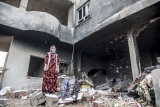
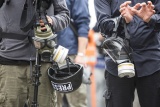
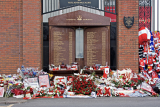
Along with emergency professionals, journalists are often "first responders" when an earthquake or a terrorist attack devastate a community. Large-scale disasters challenge reporters on the ground and newsroom managers alike, both in the midst of a breaking crisis and for months or years afterward.
On May 1, 2013, the Dart Center celebrated the 2013 Dart Awards winners and honorable mentions and presented a roundtable discussion. The conversation explored the story-behind-the-story, and drilled down on what's involved in undertaking hard-hitting, humane investigations of trauma and pursuing high-impact collaborations. Dart Foundation Vice President James Lammers and Dart Foundation Program Manager Claudia Deschaine presented the awards.
Watch our entire slate of panels from the symposium.
In the high stakes business of trauma reporting, social media has become a powerful and controversial journalistic tool. We are also only just beginning to understand how to use it. A special report in advance of our symposium on Monday, April 22, in conjunction with the Tow Center for Digital Journalism, at Columbia Journalism School: Sandy Hook and Beyond: Breaking News, Trauma and Aftermath.
Chaos descended on Boston Monday as the city's storied Boston Marathon was rocked by two bombs near the finish line. As the facts emerge, journalists can draw on lessons drawn from other large-scale terrorism and disasters.
The APA’s Division 56 is now accepting nominations for outstanding media contributions to trauma psychology. The deadline is April 15, 2013.
Poynter Online
A set of resources from David Shedden at the Poynter Institute related to the September 11th attacks.
International Society for Traumatic Stress Studies
A variety of educational materials for clinicians and individuals to use in response to terror attacks around the world.
National Center for PTSD
On the anniversary of traumatic events, some people may find that they experience an increase in distressing memories of the event. This fact sheet examines responses to the anniversary of the September 11th attacks.
Investigative Reporters and Editors
Resources compiled for past breaking news stories by Investigative Reporters and Editors, Inc. Topics include tanker crashes, earthquakes, severe winter storms, building collapses, wildfires and hurricanes.
Editor and Publisher
Joe Strupp and Doug Cosper discuss the problems faced by journalists in extreme situations, with emphasis on the challenges faced at the World Trade Center after 9/11.
National Transportation Safety Board
A brief overview to assist journalists covering the first few days of a National Transportation Safety Board accident investigation.
National Transportation Safety Board
Advice and links to other resources.
ABC Radio
2007 Ochberg Fellow Lisa Millar talks about trauma journalism on the National Media Report.
A 40-page guide to help journalists, photojournalists and editors report on violence while protecting both victims and themselves.
This documentary, available online and on DVD, features a wide range of Australian journalists their recounting experiences covering traumatic stories.
Your contributions help the Dart Center nurture informed, innovative and ethical news reporting on violence, conflict and tragedy worldwide.
The Dart Center is a project of the Columbia University Graduate School of Journalism.
© Trustees of Columbia University in the City of New York