Teaching Trauma Through Case Studies
A professor of journalism at Indiana University offers two sample assignments that teach concepts related to victims and trauma by engaging students' interest in real-world reporting.
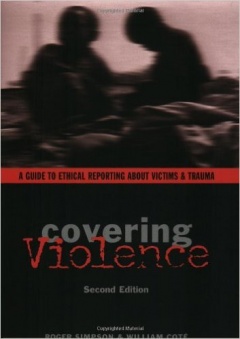
I believe ethical reporting about victims and trauma should be incorporated into courses across the curriculum, from newsgathering and media ethics to global journalism and race, gender and media. I use case studies from Covering Violence: A Guide to Ethical Reporting About Victims & Trauma, by Roger Simpson and William Cote, along with coverage of current events to accomplish this.
For my media ethics class, I use the following two-part assignment, using Covering Violence and the Dart Center website, early in the semester. Part 1: Review the book. Part 2: Present a summary of a self-study unit on the Dart Center website.
Part 1: Covering Violence Book Review
These guidelines are not meant to limit creativity, but if each student uses this framework for analyzing this book, our discussions on trauma issues are more likely to be focused and productive. The review should address the following questions:
- What is the central theme or message of the book? Consider this to be a statement of journalistic mission. Do some critical thinking about the overall focus: What are the larger or more universal issues connected to journalism and trauma?
- What evidence, arguments or reporting/research strategies do the authors use to make their most important points? Cite specific examples. How do the authors convince us that we need to pay attention to such issues as reporting on rape trauma, reporting about children or interviewing victims? Provide specific examples.
- What contribution has this book made to the literature of journalism? (This question assumes that students in an upper-level journalism class will have basic knowledge of the literature of the field.) We explored this through an Internet assignment earlier in the semester, through in-class exercises and a review of a Poynter Institute segment on ethics.
- Provide three examples of how you might use information from this book in the field as a reporter or photographer. Those of you who have worked in the field might use your own experiences. Others will need to role-play. The key here is to be specific and provide details. You would not say, “I will be more sensitive to victims.” You would say, “Here are ways I would be more sensitive to victims.”
Part 2: Distance Learning Unit Summary
Sign on to the Dart Center website and click on the “Educators” gateway. Under “Distance Learning” you can see four study units: "Journalism & Trauma"; "Covering Terrorism"; "Photography and Trauma", and "The First 24 Hours."
Choose one of these self-study units and do the following: write a summary of each segment of the unit. For instance, under terrorism, there is a section titled, “What is terrorism?” You would read that and summarize the most important information and then repeat the process for each of the following components of the unit you choose to review.
This part of the assignment should be no more than three double-spaced pages. We will discuss these in class.
Professor's Assessment
I have found students to be very receptive to these assignments, because they ask them to engage with the real world of journalism. After completing these assignments, I notice that they begin watching local, national and international media coverage of victims, trauma and violence with a far more critical eye and often bring examples into class for discussion. This is especially valuable early in the semester, as it establishes a class dynamic in which students actively apply concepts from the literature on journalism and trauma to other issues in the course.